
Feedback loops for forecasting funding, builders' programs, corporate forecasting || Forecasting newsletter #12/2025

Editorial
I’ve been wondering about the feedback loops for funding in the forecasting ecosystem. Over the last few years, a major funding source for forecasting was philanthropic funding. However, the feedback loops for that were relatively slow since one had to apply for a grant, wait up to several months to get it, and the bandwidth with grantmakers wasn’t particularly high. For instance, grantmakers didn’t really write a strategy piece to communicate their thinking.
Recently we have Polymarket and Kalshi, which have started their own builders programs, so that people build tooling for their platforms and for the broader prediction ecosystem. There, the feedback loops seem much faster: developers either win or don’t win weekly competitions. However, those builder programs are oriented towards providing value for those two platforms. This itself is not bad since it makes those projects more sustainable.
However, in keeping with the notion of a public good, I was thinking of pushing for a running hackathon, where products that met some promisingness bar would similarly have access to fast funding for maintenance and slight expansion, at something like the 10K/year level per project, within a week. This would provide faster feedback loops for public goods as well. I think I could also use this newsletter and my own distribution channels in general better to distribute promising early-stage forecasting projects. I tend to highlight projects like adj.news (a), The Base Rate Times, The Forecasting Meetup Network (a), early research (a), etc. when I find them, and I feel that that early boost in support is useful, yet in some sense also insufficient.
Over the last few years, I’ve grown to appreciate the value of distribution and decision support in addition to forecasts. I’ve come to call this the “Cassandra problem”: it doesn’t matter how right you are if your predictions are not embedded in a context such that they are used. Personally, this has led me to post more on twitter. But also, this newsletter has a few thousand readers, so if I can bring some forecasting tooling or project to you all, and get 2,000 people to sign up, give comments, complaints, encouragement, then that could be really powerful.
Lastly, the shoe is taking a long time to drop for two forecasting ecosystem dynamics: the continued legal wrangling and disputes that Kalshi is embroiled with with respect to offering prediction markets on sports. And some startup automating human forecasting away. These just keep being pushed a couple months into the future.
Prediction markets and forecasting platforms
Robinhood bought an exchange in Miami. Bearish for Kalshi, since it can be disintermediated. Robinhood also bought LedgerX, which previously belonged to FTX.
But Kalshi raised $1B at an $11B valuation, doubling value in under two months
A Kalshi cofounder complains about in her eyes unfair allegations around Kalshi and Kalshi Trading. From my perspective, famously Alameda trading brought down FTX, and if you have two tightly enmeshed firms you can have incestuous relationships that are untransparent. So it’s not like suspicion over having both an exchange and a trading arm is coming from nowhere.
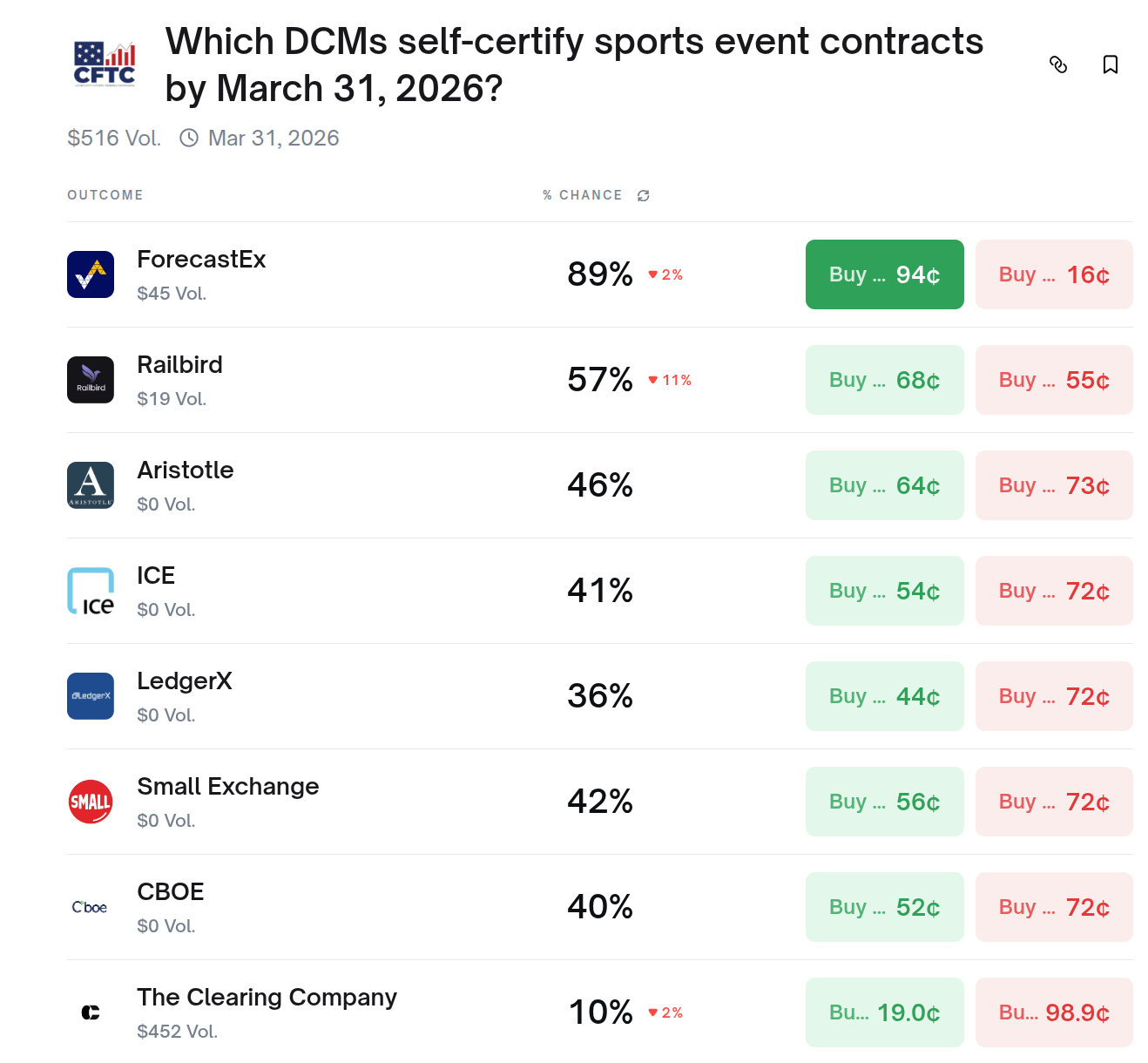
A meta-market on Polymarket: “Which DCMs self-certify sports event contracts by March 31, 2026?” Many Polymarket partnerships. Domah, a top Polymarket trader, was on 60 mins. And you can now do derivatives off Polymarket markets.
The Super.market (a) is now live.
The billion dollar valuations for Polymarket and Kalshi have led to a feeding frenzy, and we now have more platforms from FanDuel, Fanatics, the Winklevoss, Hollywood.com, TIME Magazine, Truth Social. The Roblox CEO says adding prediction market to platform is a “brilliant idea”. Oh god.
Odds and ends
If you don’t own the flow (a), don’t have any leverage.
A modern timeline (a) of US Prediction Markets. And another source on the Pre-History (a) of CFTC Regulation
Deloitte on automated sales forecasting. The money is here, in adoption of foresight methods from corporate actors. See also: Time series forecasting as a service , with a javascript SDK, built on top of open source models.
Google Finance (a) is pretty cool. It also now incorporates Kalshi and Polymarket
CEO on a financial platform talking about short-term vs long-term value in prediction markets (a).
Another spreadsheet for uncertainty. Carlo (a) seems better.
Open Philanthropy has a request for proposals for AI for forecasting and sound reasoning (a). Deadline Jan 30 2026. Half-assing a proposal here, or joining with 3-5 others to do so, seems high-expected value.
From the Twitter mentions of “fermi estimate”: “Girl who (a) is so pickme she has a Fermi estimate of number of […] customers and hence the likelihood of the barista remembering her”. And other (a) Fermi estimates from last month.
My own group, Sentinel, continues to work hard at parsing signals of large-scale global risks. We are still putting out a weekly brief (a) with summary of events, but on the background we raised $500k (a) and are now parsing Reddit and Twitter at reasonably large scale, improving our visibility into events.
Research and articles
Prophet Arena (a), Forecaster Arena. Benchmarking LLMs against predictions markets seems neat.
What’s the deal (a) with RL and forecasting?, asks Daniel Paleka.
AI forecasters better than ForecastBench (a). But ForecastBench forecasters might not be particularly well incentivized.
Friend on the newsletter Linch on predicting strategies in zero-sum oracular games (a).
Max Roser from Our World in Data on The end of progress against extreme poverty? (a). David Nash follows up (a)
Yarrow Bouchard against some research from the Forecasting Research Institute (a).
Impact forecasting for humanitarianism.
Google on forecasting the future of forests with AI (a)
Lawfare
Polymarket receives CFTC approval (a) of amended order of designation, enabling intermediated U.S. market access.
Michael Selig is nominated to be Chairman of the CFTC (a). It seems that Caroline Pham did not get the top post despite pushing out her previous boss :(
A federal judge ruled that Kalshi must stop (a) offering prediction contracts in Nevada. As a result, Crypto.com shut off access to sports conttracts in Nevada.
And more on the legal baseball (a) in US federal courts on allowing gambling. It will probably have to go to the Supreme Court (a).
Don’t Call Them Bets (a). They’re “Prediction Markets”—and Robinhood Is Getting Rich Off Them.
People with real exposure to economic activity are not making clean bets on isolated events, disaggregated from their consequences. The consequences matter.
—Matt Levine (a), Dec. 11, 2025.
Are you concerned at all that the transformation of many prediction markets into sports books will drive out the people actually interested in forecasting? Similar to how the gambling degens drove out many of the crypto-curious tech people and now crypto is awash in hucksters and scams
I agree about the Cassandra problem. Achieving highly accurate predictions becomes less relevant if these are not impactful. The forecasting ecosystem seems to excessively rely on grants and philanthropic funding, while the existing economic value of forecasting and foresight isn't being realized to its full potential. This highlights how predictions currently need to be more usable, rather than exclusively more accurate, to make the ecosystem self-sustaining.
In your view, what is currently the single biggest missed opportunity to make forecasts more usable and valuable in the real world in the immediate future?